Knife Set 2
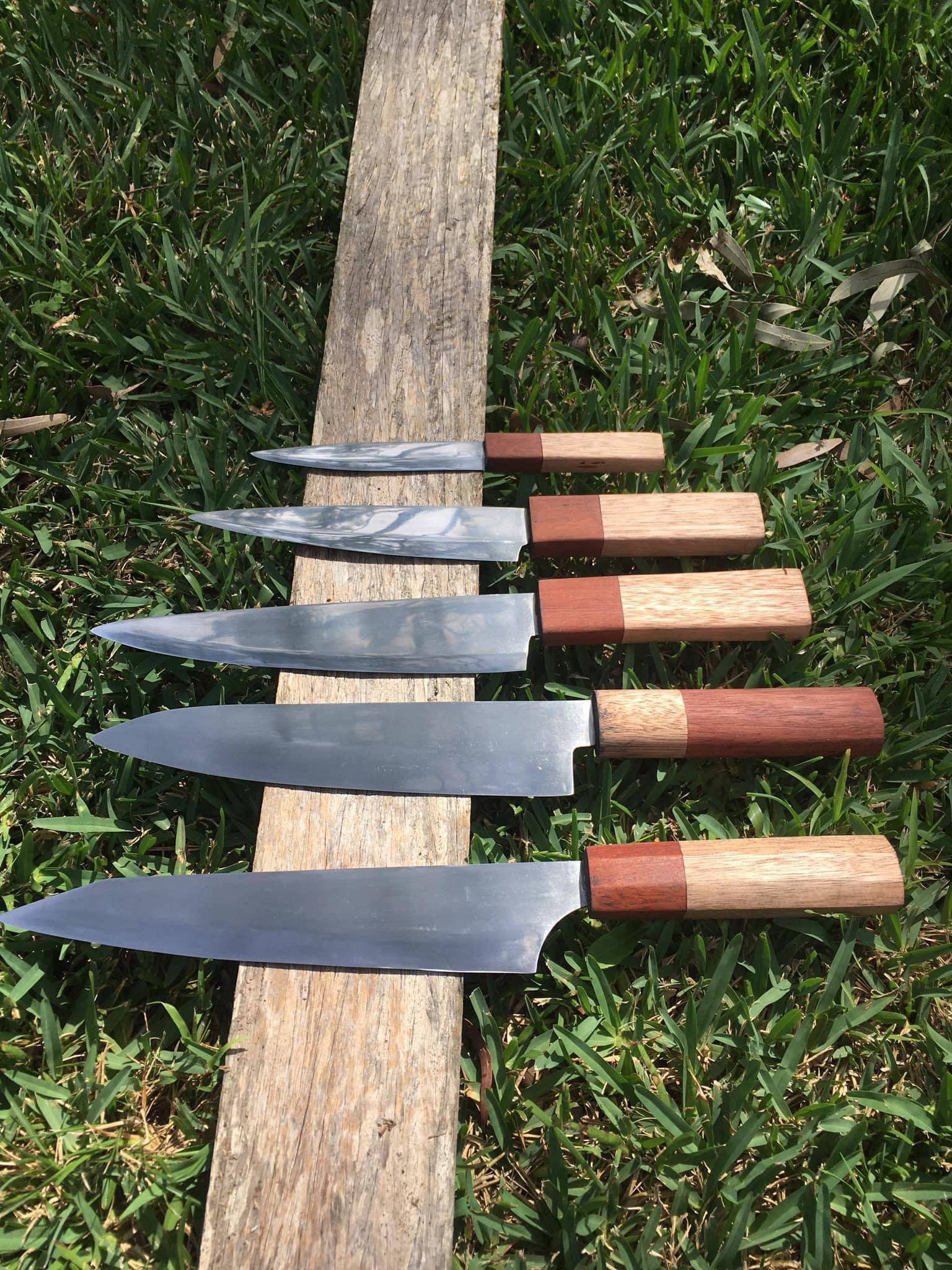
This is the second set of knives I ever made. I like to think of it as actually being the first, the real first were more of an experiment. These knives were a very big experience, not sure of the right word hahaha. Similar to the production of the first set of knives, I was using a very small grinder. It could stall the grinder just by gripping the belt with my hand, it was not very powerful. I think something like a 1 inch by 27 inch belt. I had small amount of belts as well. So the majority of grinding of these knives was done with a blunt belt. Never the less, I was able to make these blades.
So these knives are 1075 steel, supplied from Gameco Artisan Supplies in Sydney. They are quite thick, and it took a lot of grinding to get the smaller knives in the set quite thin. The two larger ones would have been impossible to grind with my little grinder, so they are still quite thick.
The little knife is one of my favourites, I use it know even today, it's great for opening letters or the pachages that keep appearing at my door with more and more knife making supplies! It is just hand, I use it to cut leather too.
The "medium" sized knife is pretty useful too, I have used it to cook, it is pretty thin, thin enough to have an ok geometry for an actual cooking knife. It has a little petina, its a little blue. It is sharp, and the handle is comfortable. It is a plain and functional tool. However, the handle is actually not on straight. All of these blades are straight, but some of the handles are on skew. A good craftsman never blames his tools, so I guess I am a bad craftsman, but the grinder was not very good at grinding even wood. Also, I just didn't drill the hidden tang holes straight, so its totally all my fault. But as I said, I did use this knife and it worked.
The middle knife (in the picture), I do not have it anymore, I gave it to my grandmother, she likes it, and she says that she always uses it when she needs an extra sharp knife.
The last two I will mention together. These were the hardest to make knives I have ever made. They took a long long time to grind, I would have been better off using a file. So if you look at either of these knives in person, you will see that the bevel starts like halfway down the blade. So they have quite a steep geometry. This has not stopped me from using these knives though. They are pretty good for chopping up big vegetables like pumpkins!
So there are a lot of lessons that I learnt from these knives. I learnt that having good tools do help a lot, there is a reason that most knife makers have a big and bulky grinder, having a small grinder means you need to take it slow, it is hard to remain patient sometimes, so you can slip up more and cause blemishes. Also, these knives, although polished to 1500 grit, are covered in scratches, scratches from a low grit belt that I could not get out when hand sanding. The knives are hardened, although, I am sceptical if the big ones are hardened enough. I only have a small furnace to do my heat treats, so I am not actually sure if they got hot enough before the quench.
Also, I did the majority of grinding before heat treating. This is somthing that a lot of knifemakers do differently, and something that I always question. I chose to do this because I thought the grinder would be poor at grinding the hardened knife. I know that a lot of makers grind to shape and then grind bevels after heat teating. I did obviously do some grinding after the heat treat, and being quite inexperienced, I did burn the edge of these knives a fair amount, so it is a bit of a miracle that they stay sharp. Anyway, since making these knives, I have stopped using them, and after forgetting to oil them, they have some surface rust. I sometimes dream of burning the handles off them and "remastering them".
Cheers, Marcus